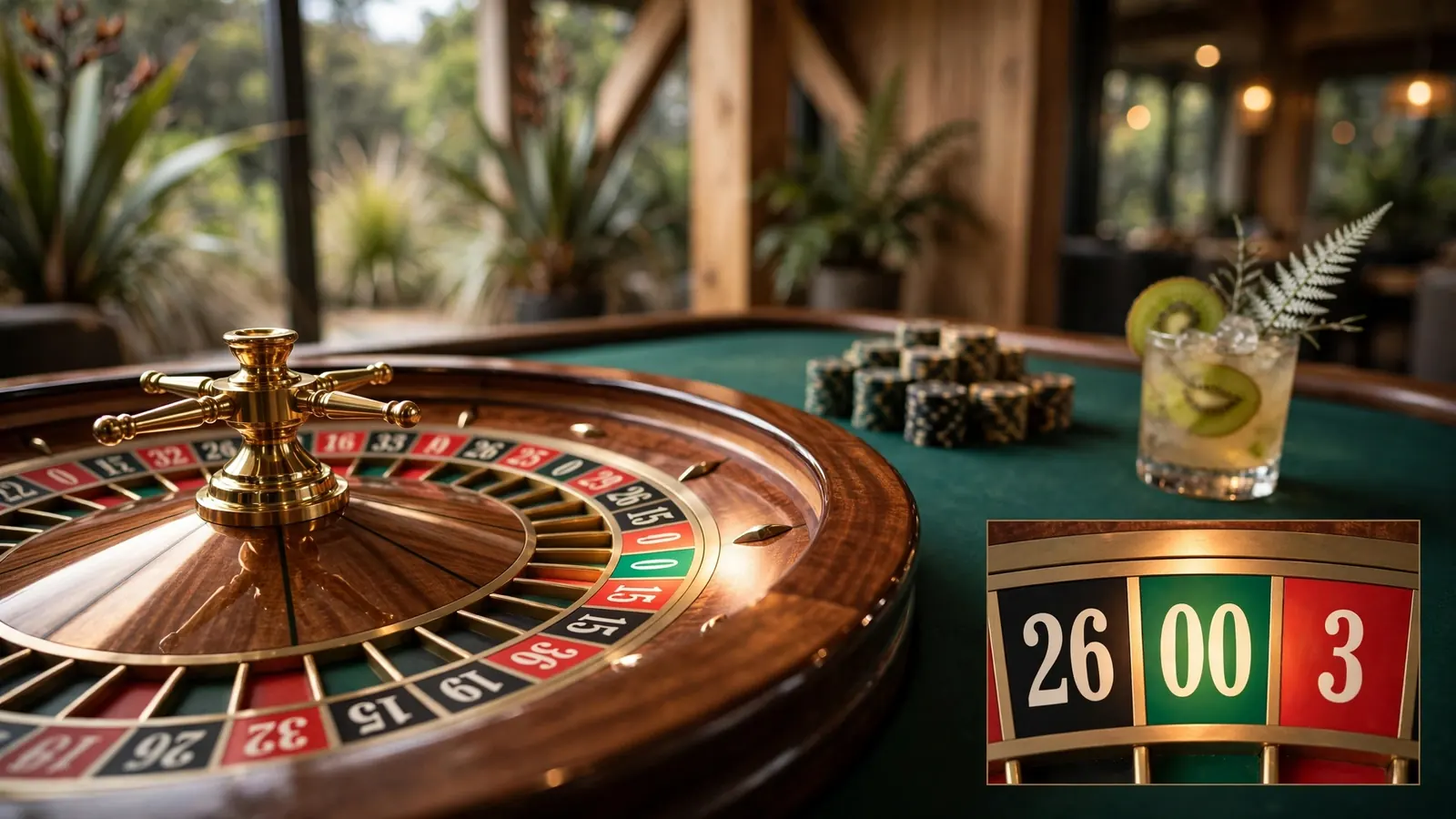
Roulette Casinos in New Zealand: Rules and Odds
 Available in US
Wheel layout, zero rules, betting limits and house edge shape how roulette plays at online casinos.

Table of Contents
- How Roulette Wheels Differ
- How a Roulette Round Works
- What to Check Before Playing Roulette at an Online Casino
- Roulette Tables, Betting Limits and Casino Offers
- Roulette at Online Casinos in New Zealand
- Roulette Tables, Free Practice and the Martingale System
- How Online Roulette Determines the Result
- Roulette Tips Without Betting-System Promises
- Live Roulette and Multi-Wheel Play
- Roulette Odds: How Wheel Rules Affect the House Edge
How Roulette Wheels Differ
Roulette formats are distinguished by the pockets on the wheel and, in some versions, by rules that apply when the ball lands on zero. That distinction matters because a bet is judged against the pockets and rules of the particular game you select. European, American and French roulette share the familiar numbered-pocket structure, but they are not interchangeable versions of the same setup.
European Roulette
A European Roulette wheel has 37 pockets: the numbers from 1 to 36 and one zero. The zero is the format’s only green pocket; the other pockets are divided between red and black. For bets based on colour or number groups, the zero is separate from those categories. It is not treated as red, black, odd or even.
The single-zero layout is the key feature to identify when comparing European roulette with American roulette. A casino roulette game labelled European should have one zero pocket, not a second pocket marked double zero. If you are choosing between tables, the format name and the wheel display tell you which layout governs the game.
Choosing a roulette casino in New Zealand means weighing the details that are actually available, such as licensing and payout speed. Use these short notes as a starting point for deciding which options to explore further.
License: 07017519840 · Payout speed: 1-3 business days Zotabet lists licence number 07017519840 and a payout speed of 1–3 business days. These details give you a starting point for checking whether it suits your roulette search.
Payout speed: 1-3 business days Lamabet lists a payout speed of 1–3 business days. You can use that information as one factor when considering it for roulette.
License: Tobique Gaming Commission, licence no. 0000002 Ricky Casino lists a licence from the Tobique Gaming Commission, number 0000002. This licensing detail may help inform your roulette casino shortlist.
License: Tobique Gaming Commission, licence no. 0000064 Neospin lists a Tobique Gaming Commission licence, number 0000064. You can take that detail into account as you explore roulette options.
License: Tobique Gaming Commission, licence no. 0000091 7Bit Casino lists a licence from the Tobique Gaming Commission, number 0000091. That is a concrete detail to consider when assessing it for roulette.
License: Malta Gaming Authority, licence no. MGA/B2C/370/2017 Play Grand lists a Malta Gaming Authority licence, number MGA/B2C/370/2017. You can use this licensing information as part of your roulette casino research.
Payout speed: 1-3 business days Wintino lists a payout speed of 1–3 business days. This gives you one practical detail to consider when looking into its roulette offering.
License: Curaçao Gaming Authority, licence no. OGL/2024/165/0185 BitStarz lists a Curaçao Gaming Authority licence, number OGL/2024/165/0185. You can factor this licensing detail into your roulette casino research.
License: Malta Gaming Authority, licence no. MGA/B2C/394/2017 N1 Casino lists a Malta Gaming Authority licence, number MGA/B2C/394/2017. This gives you a specific licensing detail to consider when exploring roulette casinos.
European Roulette is also a useful reference point for understanding the other formats. French Roulette keeps the same 37-pocket, single-zero wheel, while American Roulette adds a double-zero pocket. The wheel layout therefore affects which outcomes are possible, even though the broad categories of bets may look familiar across casino roulette games.
American Roulette
American Roulette has 38 pockets: the numbers from 1 to 36, a single zero and a double zero. Both zero pockets are distinct from the red and black numbered pockets. The added double zero is the principal layout difference from the European format.
That extra pocket changes how the layout treats bets that cover groups of numbered outcomes. For instance, a bet on red or black does not cover either zero pocket. The same separation applies to even-money categories such as odd or even: zero is outside both groups. The double zero is not another name for the single zero; it is an additional outcome on the wheel.
When a casino roulette game offers several formats, check the wheel rather than relying only on a familiar table appearance. The numbered pockets may be presented in different visual arrangements, but the relevant distinction here is the pocket count and whether the wheel includes one zero or two. American Roulette’s additional pocket means its set of possible outcomes differs from the European single-zero set.
French Roulette
French Roulette also has 37 pockets, with a single zero, so its wheel layout shares the basic pocket count of European Roulette. Its notable distinction is the availability of La Partage and En Prison rules for certain even-money bets. These rules concern what happens to an eligible bet when the ball lands on zero; they do not add another pocket or change the number of numbered outcomes.

Under La Partage, an even-money bet affected by zero loses only half its stake, with the other half returned. Under En Prison, the bet is set aside rather than settled as a loss immediately. The precise handling of a bet under En Prison depends on the table’s stated rule, so read the rule displayed for that game before choosing it. Neither rule applies to every type of wager: they are attached to qualifying even-money bets.
This is why French Roulette should not be treated as simply another name for European Roulette. The two share a single-zero wheel, but French rules can change how particular bets are settled when zero appears. If the table does not offer La Partage or En Prison, the French label alone is not enough to assume those rules apply; look for the stated conditions.
What the format name tells you
The wheel identifies the basic outcome set, while the table rules determine whether a special settlement applies. European Roulette has one zero and no extra zero pocket. American Roulette has both a single zero and a double zero. French Roulette has one zero and may apply La Partage or En Prison to eligible even-money wagers.
These differences are useful to check before you play a casino roulette game, especially if you are comparing tables that otherwise look similar. Do not infer the format from the colour scheme or the presence of familiar bet labels. Confirm the number of zero pockets and, for French Roulette, whether the relevant zero rule is stated for the bets you intend to make. Once you know those details, the format is clear without confusing wheel layout with the separate question of how a round is conducted.
Single-zero wheel with 37 pockets. It serves as a reference point for other formats.
Double-zero wheel with 38 pockets, increasing the possible outcomes compared to the European set.
Single-zero wheel with 37 pockets, featuring special La Partage and En Prison rules for even-money bets.
How a Roulette Round Works
A roulette round follows a simple sequence: you choose where to place your bets, the betting period ends, the wheel is spun, and the winning bets are settled. Your decisions happen before the result is known. In a casino, you play against the house, and your chips mark the wagers you have made.
Placing a bet
The betting layout is a numbered grid with additional areas for combinations of numbers. You place a chip on the number or group you think the ball may land on. A bet on one number is placed directly on that number; a bet covering a group goes on the relevant marked area. The placement identifies what you are backing, while the chip’s value identifies how much you have wagered.
The layout separates bets by the numbers they cover. A number bet is narrow: it wins only if the ball lands on that number. A combination bet covers more possible results, as shown by the area where the chip is placed. Outside bets cover broad groups on the layout. These distinctions are about what counts as a winning result; they do not change the basic order of a round.
At a physical table, players may use differently coloured chips so that each person’s wagers can be identified. The colours distinguish ownership, not the outcome being predicted. Place your chips carefully and make sure they sit in the intended betting area. If a chip falls on a line or is difficult to identify, the dealer may need to clarify the placement before the round proceeds.

The betting period and spin
Bets are made before the wheel is spun. While betting is open, you can choose your selections and arrange your chips on the layout. When the dealer closes betting, no further wagers can be added to that round. The wheel is then spun and the ball is released. The wheel and ball continue moving until the ball settles into a numbered pocket.
The pocket determines the result. The dealer identifies the winning number and any relevant features of that result, then compares it with the positions of the chips on the layout. A bet wins when the result falls within the selection it covers; otherwise, that wager loses. The dealer removes losing chips and pays winning bets according to the type of bet. Once the layout has been cleared and payouts handled, the table is ready for the next betting period.
This sequence explains why a bet must be in place before the spin: it records your selection for that round. Watching the wheel after betting closes does not alter the wager already on the layout. If you want to make a different selection, you do so during a later betting period, before its spin.
Chips and decisions
A chip is both a marker and a wager. Its position says what result or group of results you selected; its value says the amount at stake. In a physical casino, the dealer can help clarify where a bet belongs, but you remain responsible for checking that the chip is in the intended spot before betting closes. Once the round is underway, the layout provides the record used to settle each wager.
Roulette Round Sequence
Choose a number or group on the layout and place your chips to identify your wager and stake.
Once the dealer closes the betting period, the wheel is spun and the ball is released.
The ball settles into a pocket; the dealer identifies the winning number and pays winning bets.
At an online table, the same basic structure is represented on screen. You select a betting area and choose how much to place there. In RNG roulette, you decide when to initiate the spin after making your selections. The interface may present a countdown or a control for starting play, but the essential order remains: make the wager, start the spin, then wait for the result and settlement.
If you are learning how to play roulette at a casino, focus first on reading the layout and following that sequence. Identify the selection you want, place the chip on the matching area, and check it before betting closes. After the spin, compare the result with the numbers covered by your bet. This tells you whether the wager wins without requiring you to infer anything from the wheel’s movement.
Casino roulette is distinct from Russian roulette, which is not a casino game. In roulette, the ball’s landing place determines which wagers win; your role is to choose a marked selection before the spin. The sequence is consistent whether you play at a physical table or through an online interface, though the way you place chips and initiate a spin differs.
What to Check Before Playing Roulette at an Online Casino
Before you play roulette for real money, check what is required to open an account, how you can fund it and whether the available tables fit your intended spending. The registration and deposit steps are practical gates: players need to sign up and deposit funds before playing for real money at an online casino in New Zealand. A table that looks suitable is not enough if you cannot complete those steps on terms you understand.
Registration and account details
Read the account-opening instructions before submitting your details. Check which information the site requests, whether the details must match those used for payment, and how the account can be accessed again. If any part of the process is unclear, resolve that before depositing. Incorrect or inconsistent details can create avoidable problems when you later try to use the account or request a withdrawal.
Read the site’s account terms as well as the registration form. Pay attention to any conditions that affect deposits, withdrawals or account access. Do not assume that a prominent description of a roulette casino explains every condition attached to an account. The relevant terms should be available for you to review before you commit money.
Deposits and payment conditions
Check which deposit and withdrawal methods are available to you, and whether the same method can be used for both. Review any stated fees, transaction limits and currency-conversion conditions before making a payment. A deposit amount can be affected by conversion between currencies, so consider the amount that will leave your account rather than looking only at a displayed figure.
Some specialist casino reviews have reported a real-money roulette minimum bet as low as 10 cents at particular casinos. Treat that as a report about a specific offering, not a standard across New Zealand or a promise that the same table remains available. The minimum and maximum stakes differ between casinos and can also depend on the table you choose. Check the limits shown for the actual game before depositing, rather than assuming a figure from a review applies to every roulette table.
Account and Deposit Check
- Review account-opening instructions and ensure details match payment methods.
- Check available deposit and withdrawal methods and their associated fees.
- Verify transaction limits and currency-conversion conditions.
- Confirm the minimum and maximum stakes for the specific table chosen.
- Set a firm budget for the deposit and session length.
Decide in advance how much you are prepared to deposit and how long you intend to play. Keep those limits separate from any amount displayed as available in your account: a balance is not a reason to increase your planned spend. If the payment conditions or table limits do not fit your budget, do not proceed on the assumption that you can adjust them after depositing.
Match the table to your budget
Minimum and maximum betting limits define the range of stakes a table accepts. The minimum matters because it sets the smallest permitted bet; the maximum matters because it caps the largest one. Check both before joining. A table may have a minimum that is manageable but a maximum that is irrelevant to your plans, or the reverse. What matters is whether the permitted range lets you keep each bet within the amount you have decided to risk.
Do not use the broad label “roulette” as a substitute for checking the table information. Limits can vary by casino, so compare the displayed conditions for the games you are considering. If a limit is not clearly shown, look for an explanation in the game or account information before placing a bet.
These checks will not make roulette predictable. They help you understand the conditions under which you are choosing to play: whether you can open and use the account, what a deposit may cost, and whether the table’s permitted stakes match your plan.

Roulette Tables, Betting Limits and Casino Offers
A casino’s roulette selection is not defined by the number of tables alone. Each table has its own rules and betting limits, so check the details attached to the specific game before you join. The minimum determines the smallest permitted stake, while the maximum caps how much you can place on a bet. Both can vary between casinos and tables. A table that suits one budget may therefore be unsuitable for another.
Limits also affect how you can structure a stake. If you intend to place several bets in one round, check whether the table’s rules apply a separate maximum to each betting position or to the total stake. Do not assume that a displayed maximum applies in the same way across every bet type. Where the game information does not make the limit clear, check the table rules before staking real money.
The label “immersive” describes presentation, not necessarily the conditions of play. Look for the rules, minimum and maximum stakes, and any other table information rather than relying on a promotional description. If you are comparing casinos with roulette tables, compare those conditions directly. A larger-looking selection does not tell you whether a particular table fits your budget or preferences.
Offers need a separate check. A bonus headline does not establish whether roulette is eligible or how much roulette play contributes towards a playthrough requirement. A specialist casino review has reported that roulette’s contribution can differ between bonus terms. Treat that as a reason to read the current terms for the specific offer, not as a rule that applies across casinos. The terms should state whether roulette counts, whether it counts differently from other games, and what conditions apply before a withdrawal can be made.
- Compare wagering requirements and game contributions.
- Verify if roulette is eligible for a specific bonus.
- Read withdrawal restrictions before opting in.
- Judge an offer based solely on the headline value.
- Assume a no-deposit bonus automatically includes roulette.
- Treat bonus funds as available cash before meeting conditions.
Compare eligibility, wagering requirements, expiry, game contribution and withdrawal restrictions rather than judging an offer by its headline value. Check whether the offer is limited to selected games or excludes table games. If roulette does not count towards the requirement, playing it may not advance the bonus conditions, even when the game itself is available. A bonus can also have restrictions that affect when you can withdraw; read these before opting in.
If an offer is described as a roulette casino no-deposit bonus, verify what “no deposit” means in its terms and whether roulette is eligible. Do not infer that a bonus is usable on roulette from its name or advertisement. A specialist casino review has reported that some offers can be accessed with a $10 minimum deposit; that figure relates to offers described by that review, not a general deposit condition for casino bonuses. Confirm the requirements for the offer you are considering.
A useful comparison keeps table conditions and offer conditions distinct. First establish whether the table’s limits suit the amount you intend to stake. Then check whether the bonus changes the conditions for playing or withdrawing. If you request a withdrawal, any active or pending bonuses are void, so do not treat bonus funds as though they were available cash. These checks make it easier to assess a roulette table on its own terms and an offer by its actual restrictions, rather than by its presentation.
Roulette at Online Casinos in New Zealand
Kiwi players can access online roulette on both mobile devices and desktop computers. That means the game is not confined to a computer: you can open it on a phone or tablet as well. The device changes how you view and interact with the table, but it does not change the basic point that roulette is available online across these formats.

Before choosing where to play, distinguish access to a game from access to a real-money table. Some New Zealand online casinos provide free roulette games that you can try without depositing or registering. This lets you explore the digital table and its controls without first opening an account or putting money at risk. Free play is practice, however; it does not turn a game into a real-money session or make its results a guide to future outcomes.
Free games can also help you decide whether the screen layout is workable on your device. On a smaller screen, you may need to inspect how clearly the wheel, betting area and controls are displayed before settling into a session. On a desktop, the available space may make the table easier to view, but the game remains roulette rather than a different format. A practice option is therefore useful for checking the interface, not for identifying a more favourable result.
Welcome bonuses require a separate check. A specialist review of New Zealand casino offers reports that the vast majority of welcome bonuses are aimed at pokies rather than table games or live dealer casino. That is a description of the offers reviewed, not a promise about every casino or every promotion. If roulette is the reason you are considering an offer, do not assume that a bonus advertised for the wider casino can be used on roulette. Look at the promotion’s own terms to establish which games qualify.
This distinction matters because a casino may make roulette available while directing its welcome promotion towards a different part of its game catalogue. The presence of a welcome offer does not, by itself, tell you whether roulette is included. Likewise, being able to open a free game does not show that the same game is covered by a promotion when you play for real money.
Free roulette games allow you to explore the digital table and check the interface on your device without risking a deposit or registering an account.
For a practical comparison, check the game on the device you intend to use and see whether a free practice version is available. Then treat any welcome offer as a separate set of conditions, rather than as part of the roulette game itself. These checks help you understand what is available without assuming that every online casino presents roulette, practice play and promotions in the same way.
Roulette Tables, Free Practice and the Martingale System
A casino roulette table may be available for real-money play or as a free game for practice. These options serve different purposes. A free game lets you become familiar with the table interface and see how your selections are entered and settled, without risking a deposit. Some online casinos in New Zealand make roulette available this way without requiring you to register or deposit first. Availability depends on the casino, so a free table should not be assumed to exist everywhere.
Practice can help you understand the sequence of actions on a digital table, but it does not make future results predictable. A free game also does not reproduce the financial pressure of losing real money. Treat it as a way to learn the controls, not as evidence that a particular pattern will continue when you switch to real-money play.
How the Martingale sequence works
Martingale is a progression that responds to losses by increasing the next bet to twice the previous stake. The intended logic is that a later win will recover earlier losses and leave a gain equal to the initial stake. That calculation depends on a win arriving before the player can no longer continue the sequence.

The required stake grows quickly because every loss makes the next bet larger. For instance, after a loss, the next bet is doubled; if that bet also loses, the following stake must be doubled again. The sequence is not a fixed-size wager repeated from spin to spin. It puts more of your available funds at risk each time the outcome does not go your way.
This makes Martingale unsuitable when your budget is limited. You may reach a point where the next required bet is beyond the funds you set aside. A roulette table also has its own betting limits, so a progression can run into a maximum even if you still have money available. In either case, you cannot continue the intended sequence. Earlier losses remain, and a later win is no longer available to offset them.
The method does not change the roulette result or ensure that a win arrives in time. Doubling is a way of changing the size of your exposure, not a way to control where the ball lands. A short run of losses can therefore demand increasingly large bets without producing the recovery the system is meant to seek.
Keep practice separate from staking plans
Trying gratis casino roulette is distinct from following Martingale. In a free game, you can learn where to find the table controls and how the game presents a result without committing real money. You do not need to use a betting progression to get that practical familiarity.
Martingale Risk
Doubling bets after losses can quickly exhaust a limited budget or hit table maximums, leaving earlier losses unrecovered.
If you choose a real-money table, decide your budget before play and do not treat a loss as a reason to raise the next stake. Martingale’s doubling rule can consume a limited budget precisely when you are trying to recover losses. Free practice can familiarise you with the interface; it cannot validate that strategy or remove its financial risk.
How Online Roulette Determines the Result
In online roulette, a Random Number Generator (RNG) determines the result. The player’s action and the RNG’s role are separate: you decide when to spin, while the RNG determines the outcome. Pressing the spin control starts the game’s process; it does not let you choose the number or control where the ball lands.
This distinction matters because the timing of your click is not a prediction tool. Choosing to spin now rather than later is a decision about when to play, not a way to direct the result. The RNG, rather than the player’s timing, supplies the outcome for that spin.
The wheel and ball shown on screen communicate the result visually. In RNG roulette, the displayed animation is part of how the game presents the outcome; the decisive mechanism is the RNG. Watching the animation or waiting for it to finish does not provide a basis for predicting a later spin. Each decision to initiate a spin leads to an outcome determined by the game’s random-number process.
This also separates two ideas that can seem connected during play: initiating a round and generating its result. You control the first by choosing when to spin. You do not control the second through that choice. A pause between spins, a particular sequence of previous results or a preferred moment to click does not turn the action into a method for selecting what comes next.
When you assess an online roulette game, it is therefore useful to understand what the spin control does. It tells the game to proceed with a spin; it is not a prediction feature or a manual selector. The outcome comes from the RNG, while the animation lets you follow the game’s presentation of that outcome.
Roulette Tips Without Betting-System Promises
Useful roulette tips are about controlling your decisions, not predicting where the ball will land. A tactic can shape how you use your funds or when you stop, but it cannot make random results follow a pattern. No roulette strategy guarantees consistent winnings, and changing your choices between spins does not turn uncertainty into a reliable forecast.
Before you begin, decide how much you can afford to spend and how long you intend to play. Treat those as firm boundaries rather than targets to reach. You can set daily or weekly deposit limits and session time limits to help keep play within your plan. If you reach either limit, stop instead of extending the session because the previous spins went badly or because you feel close to a win.
Chasing losses is a decision to risk more in response to money already lost. It does not recover that money by itself, and it can push spending beyond the amount you planned. The same applies after a win: a positive result is not a reason to keep playing longer than intended. Your limit should remain in place regardless of how the session is going.
Managing Your Play
- Establish firm budget and time limits before starting.
- Avoid chasing losses by risking more to recover lost funds.
- Recognise that no strategy or tactic can predict random results.
- Use self-exclusion and account controls if it becomes difficult to stop.
Keep the distinction clear between a preference and an advantage. You might choose a particular kind of bet because you prefer its pattern of outcomes, but that choice does not guarantee a profit or alter the randomness of the result. Casino roulette tactics should not be treated as signals that a certain number or group is due. Past results do not provide a dependable prediction of the next one.
If it becomes difficult to stop, use account controls to block access temporarily or permanently through self-exclusion. These controls support a decision to pause or quit; they do not change the game’s results. A practical approach is to set your time and budget limits before playing, avoid adding funds or time to chase losses, and stop when your plan says to stop. That is a way to manage your exposure, not a method for ensuring winnings.
Live Roulette and Multi-Wheel Play
Multi Wheel Roulette changes the scope of a round: a specialist review describes it as allowing bets across several wheels in one round. Rather than treating each wheel as a separate visit to the table, you can have selections associated with more than one wheel before the results are presented. The exact interface and rules depend on the game, so check how a particular table handles your selections before committing real money.
The main effect is more results to follow, not a change to roulette’s underlying advantage for the casino. A multi-wheel format does not make a bet safer or turn several outcomes into a guaranteed return. Each wheel can produce an unfavourable result, and placing bets across more wheels can expose more of your balance to outcomes in the same round. More activity is not evidence of better odds.
Live roulette and multi-wheel play are also separate descriptions. “Live” identifies a style of casino roulette, while “multi-wheel” describes a format in which one round can involve several wheels. A table may have one feature without the other. If you are looking for a particular live game, such as one associated with Hippodrome Casino, confirm the table’s own rules and format rather than assuming that its name means it offers multi-wheel betting.

Before playing, check whether your bet applies to one wheel or several, how the game displays each result, and what happens to selections if you leave or change the table. These details affect how you track exposure and understand the outcome; they do not alter the randomness of roulette. Set a budget and a session time limit before starting, and do not increase either to recover a loss. Multi-wheel play can make a round feel broader, but it does not provide a method for predicting results or guaranteeing profit.
Roulette Odds: How Wheel Rules Affect the House Edge
Casino roulette odds depend partly on the wheel’s layout and the rules applied to a bet. The house edge expresses the casino’s mathematical advantage over time; it is not a prediction of what will happen in an individual round.
European Roulette has a house edge of 2.70%. For an even-money bet, such as red or black, the probability of winning is 48.6%. The chance is below half because the single zero does not belong to either side of the even-money bet.
American Roulette has a higher house edge: 5.26%. Its wheel has both a single zero and a double zero, so more outcomes work against the player on a standard even-money bet. This makes the European layout more favourable to players, although neither layout removes the house advantage.
French Roulette uses a single-zero wheel and may apply La Partage or En Prison to qualifying even-money bets. These rules reduce the edge because a bet affected by zero is not necessarily lost in full. Published figures for the resulting French house edge disagree: one gives 1.35%, while another gives 2.70%. The figures should not be treated as interchangeable; check which rule and calculation a table uses.
The comparison is useful when the same type of bet is available on different tables. A lower house edge means a smaller mathematical disadvantage over repeated play, not a higher chance of winning every session. Roulette outcomes remain uncertain, and a favourable rule changes the long-run calculation rather than determining where the ball lands on any particular spin.
Which roulette bet has the best odds in 2026?
Even-money bets on French Roulette with La Partage or En Prison have the lowest house edge: 1.35%.
What is the best roulette game to play?
French Roulette with La Partage or En Prison offers the lowest house edge, at 1.35%.
Which roulette version has the lowest standard house edge?
French Roulette with La Partage or En Prison has the lowest house edge: 1.35% on eligible even-money bets.
Can players win real money playing online roulette?
Yes. You can play for real money at online casinos in New Zealand after signing up and depositing funds.
What is the best bet in roulette?
Outside bets are more likely to win than inside bets, though roulette outcomes remain random.
Do roulette strategies work?
No strategy guarantees consistent winnings; roulette outcomes are random.
Is it possible to win online roulette?
Yes, online roulette can be played for real money, and a straight-up bet pays 35:1 if it wins.
Written by the editors at Casinospaymentshub.